your family update
You Backed them and things began to change

Delany D
Donor

When we first met Mathivathani, we saw a woman carrying the weight of an entire family on her shoulders. Her husband had been in an accident and could no longer use his leg, leaving him unable to work. Overnight, Mathivathani became the sole provider, the caregiver, and the only hope for their two children. Each day was a battle, managing medical expenses, feeding her family, and somehow keeping her children in school.
But survival came with an unrelenting cost. Without any strong skills to earn a steady income, and already trapped in mounting debt, Mathivathani was left with little choice but to borrow more just to get through the day. Her dreams for her children’s future felt further and further away as she struggled to keep them from slipping into the same cycle of hardship.
Behind her determined eyes, we saw both courage and quiet exhaustion, a woman doing everything she could, yet silently carrying the fear that it would never be enough. When we met her, Mathivathani’s story was one of resilience but also of deep struggle and sacrifice.

We’ve captured their voice so you can hear their story.
How is your family now?
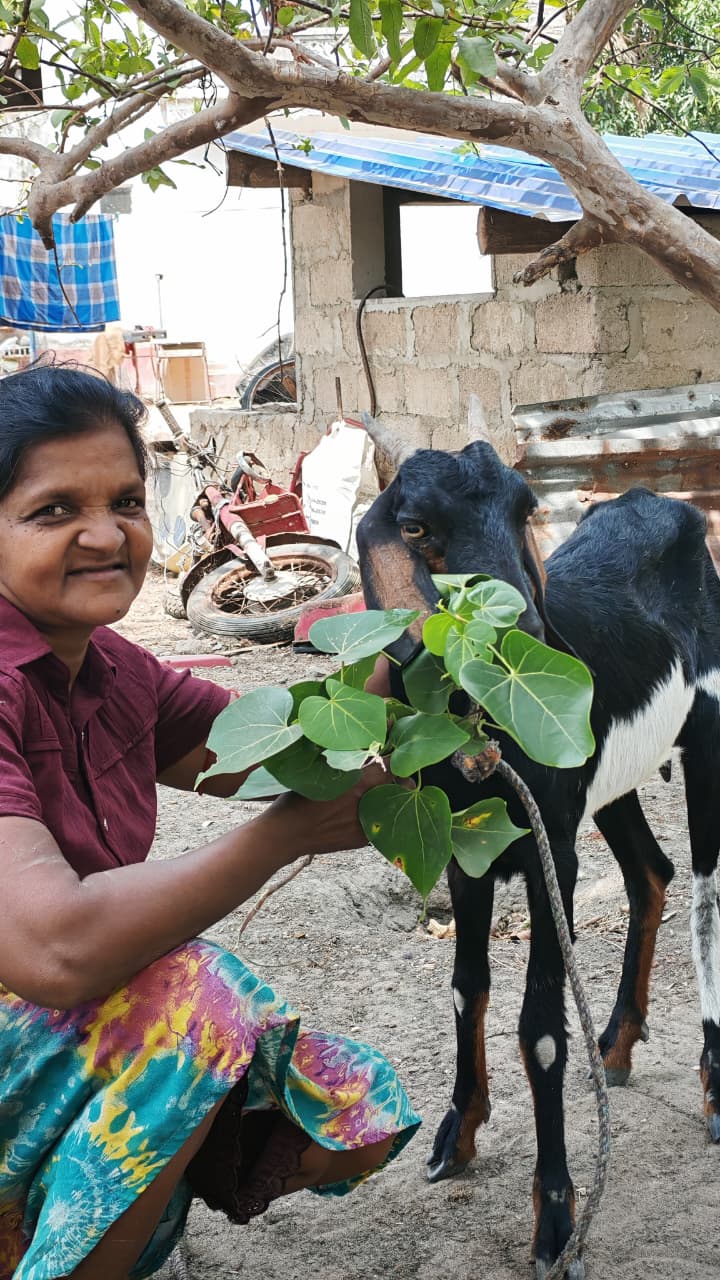
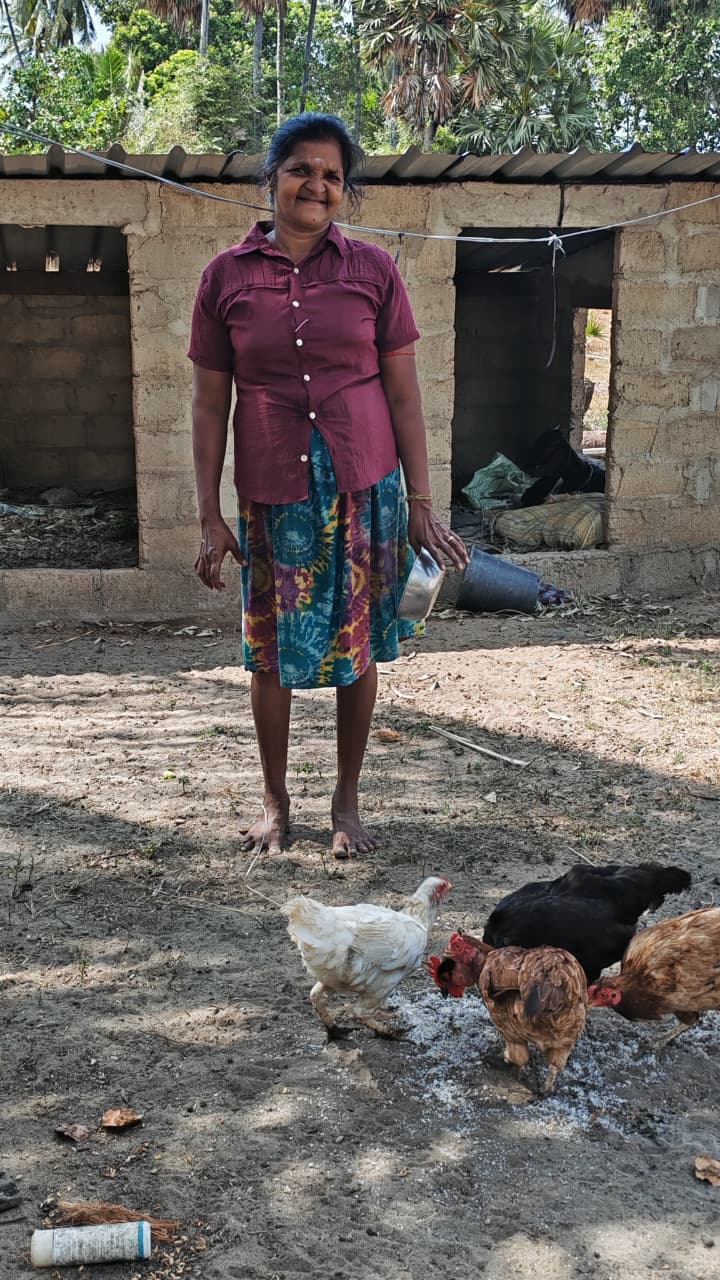
I was in a very difficult situation earlier. I have two children who drink milk. It was very difficult to send all two children to tuition classes. Even then, we ate only two meals a day. We lived like that until we received a livelihood from Palmera. We started dairy farming and sold milk, and now I have money in my hand. My children now go to tuition classes. We eat three meals a day now. We are drinking milk.
Do you think there have been changes in your family now?
Before, I had no money of my own and had to wait for whatever help came. Now I have my own income from selling milk, and I can pay my children’s tuition fees myself. We eat three meals a day. We used to drink plain tea, but now we drink milk tea. As a woman, I have gained confidence.
Have you joined these village savings groups?
(Palmera established a village bank in our community to develop financial literacy—a place where we could save and access loans to reduce our debt from predatory lenders).
Yes, I joined the village savings group because of what the other women said. I didn’t know much about it before. Since joining, I have been saving regularly and learning. I am happy about it.
(Mathivathani’s dairy income didn’t begin with the cow. Her first step was joining the women’s savings group and building the habit of saving every week, even in small amounts. She then started a home garden designed to use very little water. Only after she had shown this commitment did she plant fodder, build a shed and receive her cow. Each step prepared her for the next, which is why her income is built to last.)
What is your future goal?
I want to increase my dairy farming with 5 cows and increase my livelihood. I want to be happy; that is my expectation.
The Delany D family in Australia helped you so that your family could be happy. Do you want anything for them?
I am grateful to them for supporting us with our livelihood. I have benefited greatly from their help. I pray that they and their families live long and healthy lives. I continue to thank them from the bottom of my heart.
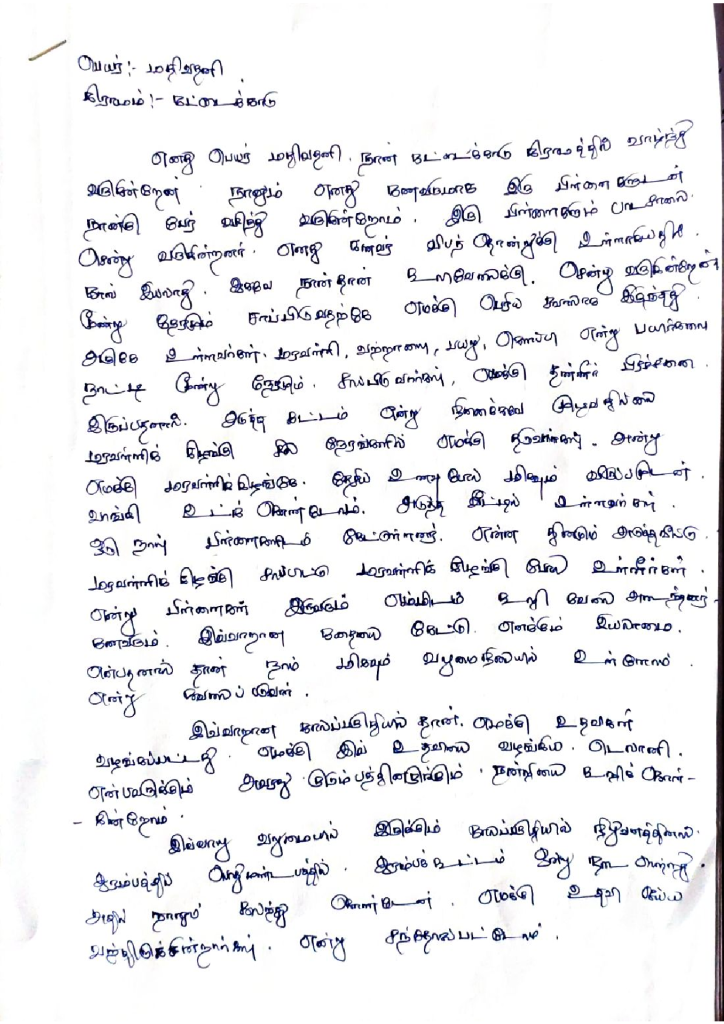
Please note for many women, sharing in written form is not easy, we support them as needed. So you can see what you have made possible we have provided additional context around her letter.
My name is Mathivathani. I live in the village of Kattakadu. The four of us, me, my husband, and our two children, live here. Both children go to school. My husband was in an accident and cannot use his leg. Because of this, I am the one who goes for daily wage labour. Cooking three meals a day was a big challenge for me.
The people nearby would grow things like cassava, sweet potato, green gram and cowpea beans. They would eat what they grew. Because I had a water problem, I couldn’t even think about planting anything. Sometimes, they would give us cassava to eat, so we used to eat what they gave us for our meals. Others in the village would bully my children, saying, “What, are you eating cassava from the next house every day and becoming fat like cassava yourself?” Hearing this, both my children would cry and feel distressed. I also felt helpless. Hearing and experiencing things like this made me sad knowing how difficult our situation was. I would worry that we were living in extreme poverty.
It was during such a time that support was provided to me from Palmera. We extend our thanks to Delany, who provided us with this help, and to her family.
During this time of poverty, an initial meeting was conducted by Palmera at the village community Hall. We also participated in it. We were happy that they had come to help us.
We women formed savings groups and saved money once a week. We regularly discussed different topics during our meetings. The women in our village came together to form these savings groups, and I attended the group meetings regularly. Seeing others save regularly made me feel sad that I could not do the same because of my financial situation. However, through the group, I also began to develop my own skills and capabilities.
(Palmera helped establish the women’s village bank so members could build the habit of saving, strengthen their financial skills and use their pooled savings for small loans rather than depending on high-cost lenders. Its value is also social: meeting each week gives women a trusted place to speak honestly, learn from one another and act together. For Mathivathani, watching her own savings grow brought peace of mind and showed her that, even from a very difficult starting point, she could begin building something of her own. Your support helped create this continuing structure around her, rather than providing only one-off assistance.)
Two months later, I saved twenty rupees as my initial contribution to the village savings group. (From that first 20 rupees, her savings in the village savings group have now grown to 38,900 LKR.) Later, after learning about the benefits of home gardening through training, I wanted to start a garden at home but felt unable to do so. When Palmera encouraged me to start one, I explained that I did not have the money needed. However, they showed me how I could do it with very little cost. They trained and encouraged me, explaining that I could use old rice sacks, seeds from vegetables I bought at the market, and a simple seedling bed to start a home garden using very little water.
In three months, the crops grew well. They started to bear fruit. The children too, in the time they have after coming back from school, would look after the crops. In the beginning, it seemed like a lot of work. Doing the home garden was a bit much for me. But we thought that if we did it, it would be good for us. We planted many different kinds of crops. The yield from the green gram was low. The other crops like eggplant and tomato, grew well. It was profitable for us.
(The home garden was designed around Mathivathani’s biggest constraint: water. Instead of treating this as a reason she could not grow food, the training showed her how to use seeds from market vegetables and plant in old rice sacks and pots that needed only a small amount of water. Mathivathani did the work herself, and her children joined her after school. Within three months, the crops were bearing food, with eggplant and tomato growing particularly well. The garden gave the family food they had produced themselves and the confidence to take the next livelihood step. Your support made the practical training and ongoing encouragement behind this progress possible.)
Palmera staff who saw my efforts offered to support me with cow rearing. I agreed and started growing grass to ensure there would be enough food for the cow. Once the grass was ready, I received the promised support to begin rearing the cow and built a good shed for it.
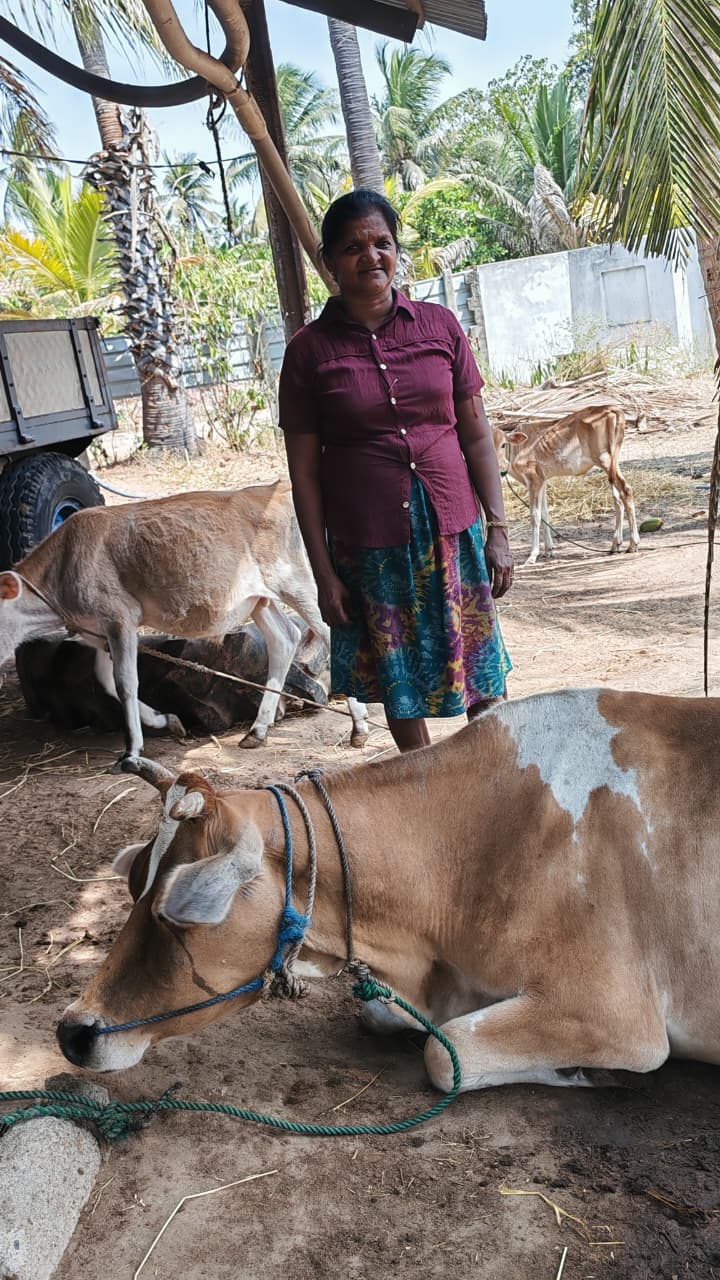
With Palmera’s support, I selected a hybrid cow and purchased it, which we raised as a member of our family. Three months after we bought it, the cow gave birth to a calf. I was quite nervous during the first delivery, but with the help of others, we cleaned and cared for the calf.
We began milking the cow and were getting around seven liters of milk a day. After keeping what we needed for our family, we sold the rest. In the very first month, after deducting the expenses, we made a net profit of 25,000 rupees. We were overjoyed.
Now, if we can sell 10 liters of milk daily as we planned, that will be enough. Also, we want to be able to harvest vegetables from our home garden, and my children should excel in their studies and have a good future.
(The cow was not provided in isolation. Mathivathani first demonstrated her commitment through regular saving and her home garden. She then planted fodder and built a shed so she was ready to care for the animal. We then ensured she was connected with the market and the government livestock service providers. Palmera doesn’t just provide a cow and leave, to get these increased liters, we provide a hybrid cow, not a local breed, and this requires a totally different way of management, which takes over a year to train and support, but these cows provide significant milk, which is enough to sustain an income.
The programme matched her preparation with a productive asset suited to her household. The cow has already produced a healthy calf, and Mathivathani began selling milk within days of the calf being born. In the first month, the household earned a profit from an income source that she now owns and manages, which will now continue to grow, and with all the connected services and markets, this income will be sustained. Your support made this step possible, while her work is what is carrying it forward.)
(Mathivathani’s goal of increasing daily milk sales shows a profound shift: she is no longer only trying to get through the next day but planning how to grow the family’s income and create a better future for her children. Her savings, garden, cow, calf and new skills remain with her after the programme ends. Together, they give the family a stronger base for food, income, and her children’s education. This is the lasting impact of your support: Mathivathani has not simply received help; she has built productive assets and the confidence to keep developing them.)
Even if Palmera were to leave us now, they have changed our lives so much through this one effort and helped us believe, “We can do it.” For all the support they have given us, we pray that God will always be with Palmera, Delany and your family. We are truly grateful for everything they have done for us.
Mathivathani
This is our final letter from Mathivathani. The programme is complete. And what she has built will not end when our work does. She came to us with no savings, no reliable income, and no clear path forward. She leaves with all three. And with the skills, confidence, and community to keep building what she has started long after this programme ends. Thank you for making all this possible. We couldn’t have done it without your generosity.